Brecon Town or Abergavenny: Where to Stay When You Arrive by Train or Bus
Brecon has the bus hub and canal-basin calm; Abergavenny has the railway station and foodie bustle. We compare both for a car-free stay in Bannau Brycheiniog.


Brecon or Abergavenny Without a Car: the Real Question
The common assumption is that both towns are interchangeable bases for Bannau Brycheiniog. They are not, and the difference matters most if you arrive by train and have no car. Abergavenny has a stop on the Transport for Wales Welsh Marches Line, with regular trains each direction between Newport, Hereford and Manchester. Brecon has no railway stop at all. That single fact reshapes everything: your walkable options, your budget for taxis, and the risk of wasting half a day waiting for a bus that does not go where you need.
Start with arrival. If you land at Cardiff Airport, a taxi to Brecon costs about £70 to £90, and there is no direct rail link. From Bristol Airport, the drive is 1.5 hours and you need a taxi to Abergavenny or Brecon. The most practical rail stop is Abergavenny. From there, a taxi into the central Beacons takes 20 minutes and costs roughly £20 to £30. If you arrive by train anywhere on the Welsh Marches Line, get off at Abergavenny. Do not change for Brecon; there is no train to change to.
| Factor | Abergavenny | Brecon |
|---|---|---|
| Railway stop | Yes: Abergavenny (Y Fenni), regular trains, direct to Newport and Manchester | No railway stop. Nearest rail connection Abergavenny, 30 minutes by X43 bus |
| Hills walkable from the platform | Blorenge (561 m), Sugar Loaf (596 m), Skirrid (486 m) all accessible on foot | None. Central Beacons require a bus or taxi |
| Bus network hub | Local services to Brecon, Crickhowell and Hay-on-Wye | TrawsCymru T4 hub. Direct buses to Cardiff roughly every 30 to 60 minutes, plus local routes |
| Central Beacons access (Pen y Fan) | Requires bus or taxi to trailhead | Direct bus service along A470 to Storey Arms and Pont ar Dafydd |
| Accommodation options | About 40 hotels, B&Bs and self-catering | About 60 hotels, B&Bs, hostels and self-catering |
| Typical double room price | £70 to £200 per night | £60 to £180 per night |
| Food reputation | Independent restaurants, annual food festival in September | Pubs, cafés, fewer fine-dining options than Abergavenny |
| Wet afternoon option | Abergavenny Museum and Castle (free, closed Mondays), indoor market (Tue-Sat) | Brecknock Museum (free, closed Sun-Mon), Theatr Brycheiniog |
| Best for | Short break without onward transport needed | Multi-day exploration using bus network |
What You Can Actually Walk to Without a Car
Abergavenny: Three Hills From The Platform
Abergavenny has a rare asset: three named hills you can reach on foot from the railway stop. The Blorenge (561 m) is a 4.5 km walk via the Monmouthshire and Brecon Canal towpath. Sugar Loaf (Mynydd Pen-y-fâl, 596 m) requires a longer 7 km approach, but it is all on public footpaths. The Skirrid (Ysgyryd Fawr, 486 m) is the shortest at 3 km. None require a bus. All three are quieter than Pen y Fan. This is the only place in Bannau Brycheiniog where you can arrive by train in the morning and be on a summit before lunch without a taxi.
Brecon: Central Base But No Walking Access To Peaks
Brecon has no walkable hills from the town centre. To reach Pen y Fan or Corn Du by foot from Brecon is a 16 km round trip on the A470, which has no pavement for much of the way. Do not attempt it. Instead, use the TrawsCymru T4 bus from Brecon bus station. The T4 runs roughly every 30 to 60 minutes during the day and stops at the Storey Arms lay-by, the main trailhead for Pen y Fan. The journey takes 15 minutes. The same bus continues to Cardiff, useful if the weather turns. The T4 is the spine of the park's public transport. Everything else is local and infrequent. Always check Traveline Cymru for live times before you travel; Welsh rural services are cut and re-tendered constantly.
The Bus Problem and the Taxi Backup
The TrawsCymru T4 connects Brecon, Merthyr Tydfil and Cardiff. It does not reach trailheads in the western Black Mountain, Waterfall Country, or the Llangattock Escarpment. For those areas, you have three choices: a taxi from the rank at Abergavenny station or Brecon bus station, a long walk from the nearest bus stop, or a combination of both. A taxi from Abergavenny to the Four Waterfalls Walk car park at Cwm Porth takes about 25 minutes and costs £35 to £45. From Brecon bus station to the same car park is 40 minutes and costs £45 to £55. Share the taxi with another hiker and split the fare.
The failure case: if you miss the last bus back, the cost of a taxi from a remote valley to Brecon can exceed £60. Check the T4 timetable before you set out, and save the local taxi company number in your phone. Download offline OS Maps before you leave accommodation; mobile signal vanishes in Waterfall Country and the Black Mountain.


Worth it if
- Abergavenny station puts three hills within walking distance, no bus required
- Brecon is better positioned for Pen y Fan and the central Beacons via the T4 bus
- Brecon has more accommodation options and lower prices
- Abergavenny has a better restaurant scene, including the annual Abergavenny Food Festival
- Abergavenny offers reliable wet-weather options with an indoor market and free museum
Skip it if
- Brecon has no railway stop, adding travel time and cost from Cardiff or England
- Brecon has no walkable hills from town; every peak requires a bus or taxi
- Public transport to Waterfall Country and the Black Mountain is poor from both towns
- Abergavenny's bus connections to the central Beacons are weaker than Brecon's
- Sunday services are reduced, with some Brecon shops closed and buses less frequent
When to Skip the Car-Free Plan Entirely
If you want to see Pen y Fan, the Black Mountain and Waterfall Country in a single trip, be honest with yourself: it does not work without a car. The three mountain ranges are 45 minutes apart by road, and no bus connects them. You will spend more time waiting for buses than walking. The single thing that most often goes wrong is assuming a postcode on a sat-nav will take you to a car park entrance. Without a car, the failure is worse: you assume a bus route will take you to a trailhead, but the bus stops 5 km short and the road has no pavement.
This trip suits the dedicated hiker who chooses one area and spends three days exploring it on foot. It does not suit the visitor who wants to tick off multiple highlights in a weekend. If that is you, hire a car at Cardiff Airport or book a guided tour that provides transport.
Read next
-

 Brecon Beacons Hotels: Country Houses, Coaching Inns and the Festival Premium
The best hotels in Bannau Brycheiniog are those you can reach by train or bus. Here are the coaching inns and country houses with a bus stop or platform nearby.
Brecon Beacons Hotels: Country Houses, Coaching Inns and the Festival Premium
The best hotels in Bannau Brycheiniog are those you can reach by train or bus. Here are the coaching inns and country houses with a bus stop or platform nearby.
-
 Where to Stay in the Brecon Beacons Ranked by What You Can Reach on Foot
The best base in Bannau Brycheiniog is the one where you can lace your boots and walk onto the hill. Here is every town ranked by what leaves from the door.
Where to Stay in the Brecon Beacons Ranked by What You Can Reach on Foot
The best base in Bannau Brycheiniog is the one where you can lace your boots and walk onto the hill. Here is every town ranked by what leaves from the door.
-
 Flying into Bannau Brycheiniog via Cardiff Bristol and Birmingham
Flying into Bannau Brycheiniog: how to reach the park by train and bus from Cardiff, Bristol and Birmingham airports, with taxi costs where public transport fails.
Flying into Bannau Brycheiniog via Cardiff Bristol and Birmingham
Flying into Bannau Brycheiniog: how to reach the park by train and bus from Cardiff, Bristol and Birmingham airports, with taxi costs where public transport fails.
-
 Things to Do in Bannau Brycheiniog Sorted by Whether You Have a Car
Some of Bannau Brycheiniog's finest walks begin at bus stops. Others require a taxi or a long approach on foot. Here is every major activity sorted by access.
Things to Do in Bannau Brycheiniog Sorted by Whether You Have a Car
Some of Bannau Brycheiniog's finest walks begin at bus stops. Others require a taxi or a long approach on foot. Here is every major activity sorted by access.
-
 Best Time to Visit Bannau Brycheiniog Month by Month Including Daylight Hours
August brings queues to Pen y Fan's summit, November loses the light by four, and the Royal Welsh Show swallows every bed for miles. Here is the park month by month.
Best Time to Visit Bannau Brycheiniog Month by Month Including Daylight Hours
August brings queues to Pen y Fan's summit, November loses the light by four, and the Royal Welsh Show swallows every bed for miles. Here is the park month by month.
-
 Getting Around the Brecon Beacons Without a Car: What Runs and What Does Not
No bus reaches the trailheads of Bannau Brycheiniog. Here is what the TrawsCymru network does serve, and what to do when the tarmac runs out.
Getting Around the Brecon Beacons Without a Car: What Runs and What Does Not
No bus reaches the trailheads of Bannau Brycheiniog. Here is what the TrawsCymru network does serve, and what to do when the tarmac runs out.
-
 Pen y Fan
 can be climbed from the Storey Arms bus stop on the TrawsCymru corridor, with quieter alternatives from Cwm Gwdi and a long walk-in from Brecon.
Pen y Fan
Pen y Fan can be climbed from the Storey Arms bus stop on the TrawsCymru corridor, with quieter alternatives from Cwm Gwdi and a long walk-in from Brecon.
-
 Waterfall Country
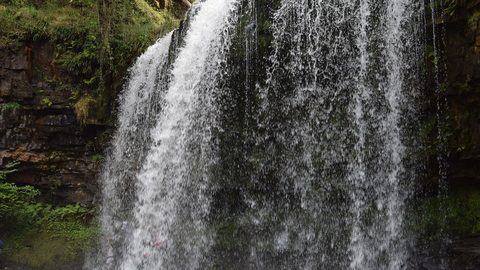
's Four Waterfalls Walk is reachable by a long road-walk from the nearest bus stop or by taxi from Abergavenny station, with slippery paths year-round.
Waterfall Country
Waterfall Country's Four Waterfalls Walk is reachable by a long road-walk from the nearest bus stop or by taxi from Abergavenny station, with slippery paths year-round.
-
 Llangorse Lake
 is a short, flat walk from the bus stop on the TrawsCymru corridor from Brecon, with a crannog, bird hides, and watersports at the water's edge.
Llangorse Lake
Llangorse Lake is a short, flat walk from the bus stop on the TrawsCymru corridor from Brecon, with a crannog, bird hides, and watersports at the water's edge.